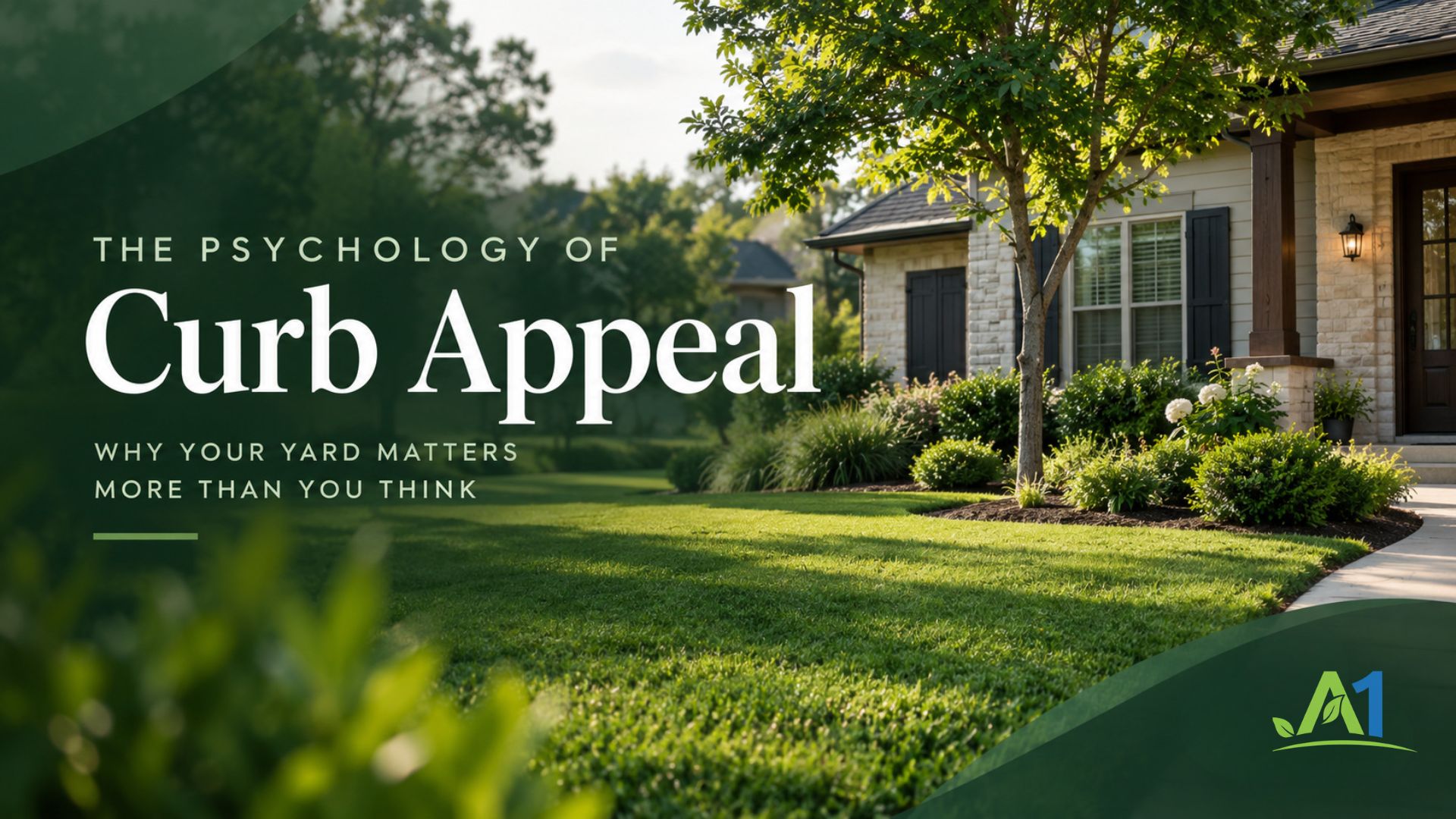
There’s a moment that happens every time someone pulls into a driveway, walks up to an open house, or drives past a neighbor’s place on a Sunday afternoon. It happens fast, and it happens whether the person means for it to or not.
They look at the yard. And before anybody says a word, the yard has already started talking.
We’ve spent a lot of time these past few months on the how of lawn care — sod installation, irrigation systems, hardscape design, winter protection. Good, practical stuff. But this week we wanted to step back and talk about the why. Why does a well-kept yard matter so much to people? Why do we feel proud pulling into a driveway with a clean, green lawn, and a little uneasy pulling into one that’s overgrown and neglected — even when nothing is actually wrong?
Turns out, there’s real research behind this. Some of it goes back decades, some of it is brand new, and all of it points to the same conclusion: your yard isn’t just landscaping. It’s communication.
The Money Side of the Story
Let’s start with the part everybody wants to know first — does curb appeal actually matter to your home’s value, or is it just something Realtors say to get you to buy mulch?
It matters. A study published in the Journal of Real Estate Finance and Economics found that homes with strong curb appeal sell for an average of 7% more than comparable homes with poor curb appeal. Not a marketing claim — a peer-reviewed study, looking at real sales data.
And the real estate professionals who work these deals every day agree. According to the National Association of Realtors, 97% of realtors believe curb appeal is important to attracting buyers, and 92% have specifically recommended that sellers improve their curb appeal before listing a home. When almost every single person in an industry agrees on something, it’s worth paying attention.
But here’s what’s more interesting than the percentages. It’s the why behind them.
Why We Judge a House by Its Yard
Human beings are wired to size up an environment fast, without even realizing they’re doing it. We look at a space and form an impression — safe or unsafe, cared-for or neglected, welcoming or not — almost automatically. And that impression doesn’t stay tied to the property. It transfers to the person who owns it.
A tidy, well-maintained yard signals competence. It signals conscientiousness. It signals that whoever lives there is invested in their community and can be counted on. A neglected yard sends the opposite message, whether that’s fair or not. We’re not always conscious we’re making these judgments, but we make them anyway — about the house, and about the people behind it.
This isn’t vanity or nosiness. It’s baked into how humans process the world around them, and there’s some fascinating research explaining exactly why.
We’re Still Looking for Shelter — Even in the Front Yard
Back in 1975, a geographer named Jay Appleton proposed something called Prospect-Refuge Theory. The idea is that humans evolved in environments where survival depended on two things: being able to see danger coming from a distance (prospect), and having a safe, defined place to retreat to (refuge). Landscapes that offer both of those qualities together feel deeply, instinctively pleasing to us — even now, even though most of us haven’t worried about a predator sneaking up on us in a very long time.
Think about what that means for a front yard. A lawn with clear sight lines, defined borders, structured plantings, and a clean edge along the walkway — that’s prospect and refuge working together. It feels safe. It feels right, even if the person standing there couldn’t tell you why.
An overgrown yard with tall grass, sightlines blocked by unmanaged shrubs, and no clear sense of where the “safe” space ends and the wild space begins? That does the opposite. It creates a small, nagging sense of unease — not because there’s any actual danger, but because something in us, going back a long way, doesn’t like not being able to see what’s there.
Why We All Love the Same Kind of Yard
There’s a related idea called the Savanna Hypothesis, put forward by researcher Gordon Orians in 1980. He proposed that humans have an evolved aesthetic preference for landscapes that resemble the African savanna — open, park-like settings with scattered trees, water, and good visibility in every direction.
This one goes a long way toward explaining why certain landscape features show up again and again, in yard after yard, region after region, culture after culture: open lawn areas. A single specimen shade tree standing apart from the tree line. A pond or water feature. These aren’t just design trends. In a sense, we’re recreating the landscape our species called home for most of its history, right there in our own front yards.
It’s part of why a well-placed shade tree and a healthy stretch of open lawn just feels good to look at, even to people who couldn’t explain the science behind it.
The Neighborhood Effect
Now here’s where it gets bigger than any one yard.
Back in 1982, criminologists James Q. Wilson and George Kelling wrote a piece for The Atlantic Monthly introducing what’s become known as “Broken Windows Theory.” Their argument, at its core: visible signs of disorder and neglect in a neighborhood signal that nobody is watching and nobody cares — and that signal can actually encourage further deterioration.
Applied to yards, this plays out in a very real feedback loop. A well-kept yard tends to encourage the neighbors to keep their own places up. Neglect, on the other hand, tends to spread the same way.
And it’s not just a hunch. A 2025 study on physical disorder and neighborhood perceptions, published in the Journal of Urban Affairs, found that visible signs of neglect significantly increased people’s perceived sense of risk in an area — even in places where actual crime rates were low. Appearance shapes how safe a place feels more than the statistics do. People aren’t walking around with crime data in their heads. They’re reading their surroundings, and yards are a big part of what they’re reading.
Keeping Up With the Joneses Isn’t What You Think
There’s a phrase we’ve all heard — “keeping up with the Joneses” — usually said with a little bit of an eye roll, like it’s about vanity or competition for its own sake.
But the psychology behind it is older and more human than that. Leon Festinger’s Social Comparison Theory, from 1954, is well documented: people naturally evaluate themselves by comparing themselves to others around them. In a landscaping context, that’s the real engine behind wanting your yard to look as good as the one next door. It’s not pure vanity. It’s a genuine, deep-seated human need for belonging and community standing — wanting to feel like you’re pulling your weight on the street you live on.
There’s nothing wrong with that instinct. Most of us want to feel like a good neighbor, and a cared-for yard is one of the most visible, honest ways of showing it.
Good Yards Are Good Neighbors
Here’s the part we think gets missed the most: your yard care isn’t just about you.
A study from 2000 (Luttik) found that attractive views — including well-maintained gardens and green space — increased property values for neighboring properties by 5-12%. Not just the house doing the maintaining. The houses next door, across the street, down the block.
That’s worth sitting with for a second. When you keep your yard up, you’re not just investing in your own place. You’re contributing something real to your whole street — to the family next door, to the folks who walk their dog past your house every evening, to the overall feel of the neighborhood you’ve chosen to raise your family in. That’s a pretty good reason to care for a yard, separate from resale value or curb appeal scores. It’s just good neighboring.
Around here, in Lufkin and Nacogdoches and the towns in between, that idea isn’t new. Deep East Texas has always understood that a community is made up of individual choices — how you keep your fence line, how you wave at folks on your evening walk, how you take care of what’s yours so the whole street looks like somewhere people are proud to live.
What This Means for Your Yard
None of this is about perfection. Nobody’s front yard needs to look like a magazine cover. But understanding the psychology behind curb appeal helps explain why the basics matter so much — mowing on a regular schedule, keeping edges clean and defined, maintaining healthy grass instead of bare or weedy patches, and giving your landscape some visible structure instead of letting it grow in without a plan.
Those aren’t just aesthetic choices. They’re signals — to buyers if you’re selling, to neighbors if you’re not, and honestly, to yourself, every time you pull into your own driveway.
The Bottom Line
A well-kept yard says something before you ever open your mouth. It says you’re paying attention. It says you take care of what’s yours. It says something about the kind of neighbor you are, and it does real, measurable good for the people around you — not just for your own bottom line.
That’s not marketing talk. That’s decades of research in real estate economics, environmental psychology, and criminology, all pointing at the same simple truth: what you do with your yard matters more, and reaches further, than most of us ever stop to think about.
If your yard isn’t saying what you want it to say right now, that’s fixable. Sometimes it just takes a mow schedule, an edge job, and a little bit of structure. Sometimes it’s sod, irrigation, or a landscape refresh. Either way, we’d be glad to help you get there.
A1 Lawn & Landscape proudly serves Lufkin, Nacogdoches, and surrounding East Texas communities. 📞 Call 936-635-0555 for a free estimate.
Author: Billy Forrest