
Stop Wasting Water: The Smart Irrigation Guide for Lufkin Homeowners
Most folks think of an irrigation system as something you set once and forget. You punch in a schedule, the sprinklers pop up a few mornings a week, and that’s that. We get it — that’s how these systems have worked for decades.
But here’s the problem. That “set it and forget it” approach is quietly wasting a staggering amount of water, running up your bill, and in a lot of cases, doing your lawn more harm than good.
At A1 Lawn & Landscape, we design and install irrigation systems all over Lufkin, Nacogdoches, and the surrounding East Texas communities, and we can tell you from experience — the biggest difference between a system that works and a system that wastes money almost never comes down to the pipes or the sprinkler heads. It comes down to the controller. The little box in your garage telling the whole system when and how long to run.
Let’s talk about why that matters, and what you can do about it.
The Scope of the Problem
This isn’t a small issue. The EPA’s WaterSense program reports that residential outdoor water use accounts for nearly 8 billion gallons of water every day across the country, and the lion’s share of that goes toward landscape irrigation.
To put that in household terms: the average American family uses about 320 gallons of water a day, and roughly 30% of that — close to 96 gallons — goes to outdoor uses like watering the lawn and landscape beds. In arid parts of the country, outdoor water use can climb as high as 60% of total household consumption.
East Texas isn’t arid. We get roughly 49 inches of rain a year around here, which sounds like plenty. But that rainfall doesn’t fall on a neat, even schedule. We’ll go through stretches of steady spring rain and then hit a bone-dry August where the ground cracks open. That unevenness is exactly why irrigation systems stay busy here even in a “wet” region — and it’s exactly why smart water management matters just as much in Lufkin as it does in Phoenix.
Where All That Water Actually Goes
Here’s the number that should get every homeowner’s attention: the EPA estimates that as much as 50% of the water used outdoors is lost to wind, evaporation, and runoff caused by inefficient irrigation methods and systems.
Half.
That means for every dollar you spend running your sprinklers, roughly fifty cents of it might be doing absolutely nothing for your lawn. It’s blowing off in the wind, evaporating off hot pavement, or running off your yard into the street before it ever soaks into the root zone.
And if that irrigation system isn’t properly maintained — a stuck valve, a broken head, a controller that doesn’t account for rain — a single household can waste up to 25,000 gallons of water in a year. That’s not a typo. Twenty-five thousand gallons, gone, for nothing.
We see this constantly on service calls. A homeowner calls us because their water bill jumped, or because part of the lawn is drowning while another part is going brown, and nine times out of ten the system is just running on autopilot with no regard for what the weather’s actually doing.
The Single Best Upgrade You Can Make
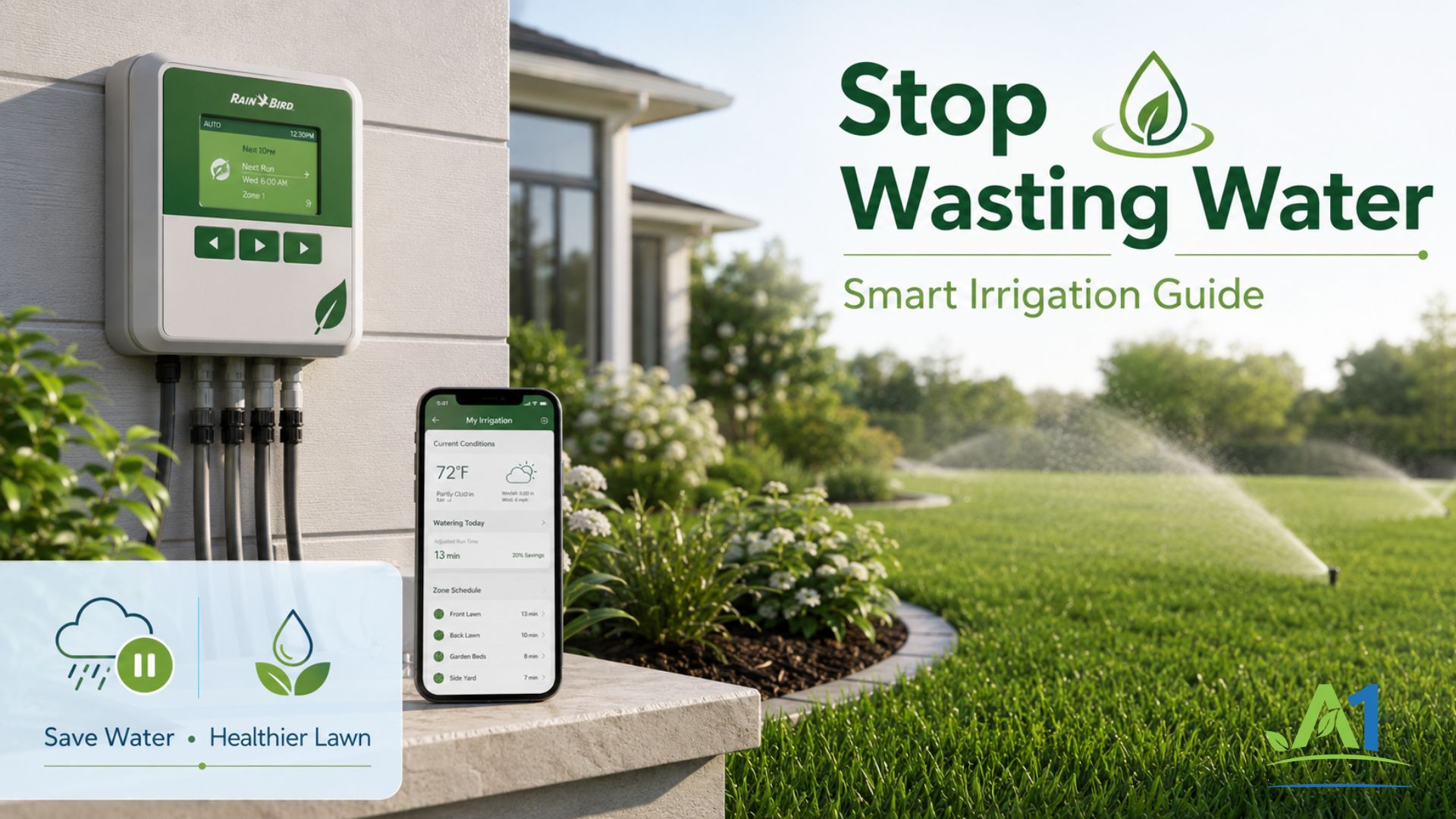
If you already have an irrigation system installed, there is one upgrade that outperforms almost everything else you could spend money on: replacing your standard clock-based controller with a WaterSense-labeled smart controller.
A standard controller is dumb, plain and simple. It runs on the schedule you set — say, three mornings a week for 20 minutes per zone — whether it rained an inch last night or hasn’t rained in three weeks. It has no idea what’s actually happening in your yard.
A smart controller fixes that. These systems generally work one of two ways:
- Weather-based (ET) controllers pull in local weather data — temperature, humidity, wind speed, solar radiation, and rainfall — and use it to calculate something called evapotranspiration, or “ET” for short. That’s simply the combined water loss from soil evaporation and plant transpiration. The controller uses that number to figure out exactly how much water your landscape actually needs that day, and adjusts the schedule automatically.
- Soil moisture-based controllers take a more direct route. Sensors buried in the soil measure actual moisture levels in the root zone, and the system simply won’t irrigate if the soil is already adequately moist — rain or no rain in the forecast.
Both types increasingly connect to your smartphone, so you can check on your system, adjust a schedule, or shut it down entirely from wherever you are. That convenience is a big reason we’re seeing more and more homeowners — especially younger ones — make the switch.
What This Actually Saves You
The EPA has the numbers on this, and they’re worth sitting with. Replacing a standard clock-based controller with a WaterSense-labeled smart controller can save the average home up to 15,000 gallons of water annually and cut irrigation water use by up to 30%.
Zoom out to a national scale and it gets even more impressive. If every home in the U.S. with an automatic sprinkler system properly used a WaterSense-labeled controller, the EPA estimates the country could save up to $4.5 billion in water costs and 390 billion gallons of water every year. That’s roughly equal to the yearly household water needs of about 5 million average American homes.
You don’t need to save the whole country’s water supply to make this worth it, though. You just need to look at your own water bill and your own lawn.
Why This Matters Even More on East Texas Clay
Here’s something a lot of national irrigation companies don’t tell people, mostly because they don’t know our dirt. Much of the soil around Lufkin and Nacogdoches is heavy clay, and clay has a low infiltration rate — meaning water can only soak into it so fast before it starts pooling and running off.
That has real implications for how your system should be programmed. A single long soak — say, 20 straight minutes on one zone — often does more harm than good on clay soil, because the ground can’t absorb it fast enough. Most of that water ends up running off into the driveway, the street, or the flower bed downhill instead of reaching the grass roots that need it.
The better approach on East Texas clay is shorter, more frequent cycles that give the soil time to absorb each round before the next one starts. This is often called “cycle and soak,” and it’s a technique we build into every irrigation design we do — regardless of whether the system has a smart controller or not.
Pair that cycle-and-soak approach with a smart controller that’s factoring in actual rainfall and weather data, and you’ve got a system that’s finally working with our soil and our climate instead of against it. A rain sensor alone helps some. A true smart controller does far more, because it’s not just reacting to rain that already fell — it’s calculating what your lawn needs before it ever turns on.
Protecting the Investment You’ve Already Made
If you’ve invested in sod, landscape beds, trees, or hardscaping, your irrigation system isn’t just a convenience — it’s the thing keeping all of that alive and looking good. A poorly managed system can undo thousands of dollars of landscape investment through overwatering (root rot, fungus, disease) or underwatering (dead sod, stressed trees) just as easily as no irrigation at all.
There’s also a real number on the investment side worth knowing. According to the National Association of Realtors’ Remodeling Impact Report, installing an irrigation system costs an average of $6,000 and recovers about 83% of that cost at resale. That’s one of the better returns you’ll find in outdoor home improvement — and it only holds up if the system is designed correctly and maintained well. A system that’s leaking, running off, or watering on a fixed schedule regardless of conditions isn’t protecting that investment; it’s slowly working against it.
A Resource Worth Knowing About
If you want to get into the weeds on evapotranspiration data for our part of Texas, Texas A&M AgriLife Extension maintains the Texas ET Network, which delivers real-time evapotranspiration data from weather stations across the state. It’s a great free resource for homeowners who want to understand exactly how much water their landscape needs on a given week, and it’s the same kind of data that a quality weather-based smart controller is pulling from automatically.
What A1 Recommends for Lufkin and Nacogdoches Homeowners
We design every irrigation system we install with East Texas conditions in mind — not a generic national template. That means zoning based on your specific soil, sun exposure, and plant material, programming cycle-and-soak schedules that actually work on our clay, and recommending WaterSense-labeled smart controllers as the standard, not the upsell.
If you already have a system that’s a few years old, it’s worth having it evaluated. A lot of irrigation systems around here are still running on the same clock-based controller they were installed with 10 or 15 years ago, quietly wasting thousands of gallons every season without anyone noticing until the water bill does the noticing for them.
The Bottom Line
Irrigation isn’t about running your sprinklers more. It’s about running them smarter. The EPA’s own research shows that up to half of all outdoor water use in this country is wasted through inefficient systems, and the single best fix — a WaterSense-labeled smart controller — can cut your irrigation water use by up to 30% while keeping your lawn healthier in the process.
On East Texas clay, with our unevenly distributed rainfall, that kind of smart, responsive watering isn’t a luxury. It’s just good stewardship — of your water, your money, and the lawn you’ve worked to build.
A1 Lawn & Landscape proudly serves Lufkin, Nacogdoches, and surrounding East Texas communities. 📞 Call 936-635-0555 for a free estimate.