
If you’ve ever stood on your porch during a good East Texas downpour and thought, “That’s an awful lot of water just running off into the ditch,” you’re not wrong. And you’re not alone. More and more homeowners around Lufkin and Nacogdoches are asking us about rainwater harvesting—not as some fringe survivalist idea, but as a genuinely practical way to water a lawn, fill a flower bed, or cut down a water bill.
The good news is that Texas makes this easier than a lot of people expect. Between favorable state law and a climate that gives us plenty of rain to work with, this is one of those rare home improvement projects where the numbers, the legal framework, and the local weather all line up in your favor.
We want to walk you through what the law actually says, what the real-world math looks like, and how to think about getting started—plainly and honestly, the way we’d explain it to a neighbor.
Texas Actually Wants You to Do This
A lot of states treat rainwater harvesting as an afterthought at best, or a legal gray area at worst. Texas is different. According to the Texas Water Development Board, which actively promotes rainwater harvesting as part of the state’s broader water conservation strategy, Texas has built one of the most supportive legal frameworks in the country for homeowners who want to collect and use rainwater.
That’s not marketing language—it shows up directly in the law. Here’s what’s on the books:
- Your HOA can’t stop you. Texas Property Code Section 202.007 prevents homeowners associations from banning rainwater harvesting installations outright. If you live in a deed-restricted neighborhood and you’ve been told a rain barrel or cistern isn’t allowed, that’s worth a second look. An HOA can regulate reasonable details like placement or screening, but it cannot simply forbid the practice.
- No sales tax on the equipment. The Texas Tax Code exempts rainwater harvesting equipment from sales tax. That includes the tanks, filtration components, and related hardware that go into a proper system.
- Property tax exemptions exist too. Under the Texas Water Code, rainwater harvesting systems can qualify for property tax exemptions, meaning the value a system adds to your property isn’t necessarily going to bump up your tax bill the way some other home improvements might.
Put those three things together and you’ve got a state government that isn’t just tolerating rainwater collection—it’s actively clearing the path for it. And it’s working. The Texas Water Development Board has documented a 22% increase in rainwater harvesting system installations across the state in recent years, which tells you this isn’t a niche hobby anymore. It’s a mainstream water strategy for a growing number of Texas homeowners.
One quick caveat worth mentioning: while the state framework is favorable, some local municipalities and utility districts can have their own permitting rules, especially for larger systems tied into plumbing. It’s always worth a quick check with your local building department before you install anything beyond a simple rain barrel—cheap insurance against a headache later.
Why This Makes Even More Sense in East Texas Specifically
Rainwater harvesting works better in some parts of Texas than others, simply because of how much rain actually falls from the sky. West Texas and the Panhandle get a fraction of what we do. Deep East Texas is a different story entirely.
Our region averages around 49 inches of annual rainfall, making Lufkin and the surrounding area one of the wetter parts of the state. That matters a lot when you’re talking about a system that depends on rain showing up regularly enough to be worth collecting.
Here’s the math that makes it real. According to the standard formula used by the Texas Water Development Board’s Texas Manual on Rainwater Harvesting, you can theoretically collect roughly 0.62 gallons of water per square foot of roof or catchment surface for every inch of rainfall that falls.
Do that math on an average East Texas home. A modest 1,500-square-foot roof footprint, at 0.62 gallons per square foot per inch, times 49 inches of annual rainfall, works out to more than 45,000 gallons of water theoretically available off your roof alone in a single year.
Now, that’s the theoretical number, and real-world systems don’t capture all of it. Evaporation, splash-out during heavy storms, and something called “first flush” losses—the initial dirty runoff from a roof that’s diverted away before clean water starts flowing into the tank—all cut into that total. Realistically, most well-designed systems capture somewhere between 75% and 90% of the theoretical yield. Even on the conservative end, that’s still tens of thousands of gallons a year off a typical East Texas roof. That’s not a rounding error. That’s a real, usable amount of water.
What a System Actually Looks Like
One of the biggest misconceptions we run into is that rainwater harvesting means a big, expensive, complicated setup. It doesn’t have to. Systems range from dead simple to genuinely sophisticated, and where you land on that spectrum depends entirely on what you want the water for.
On the simple end, you’ve got rain barrels—typically 50 to 100 gallons—connected directly to a downspout. These are popular for watering garden beds, container plants, and small landscaped areas. They’re inexpensive, easy to install, and a great starting point if you’ve never done this before.
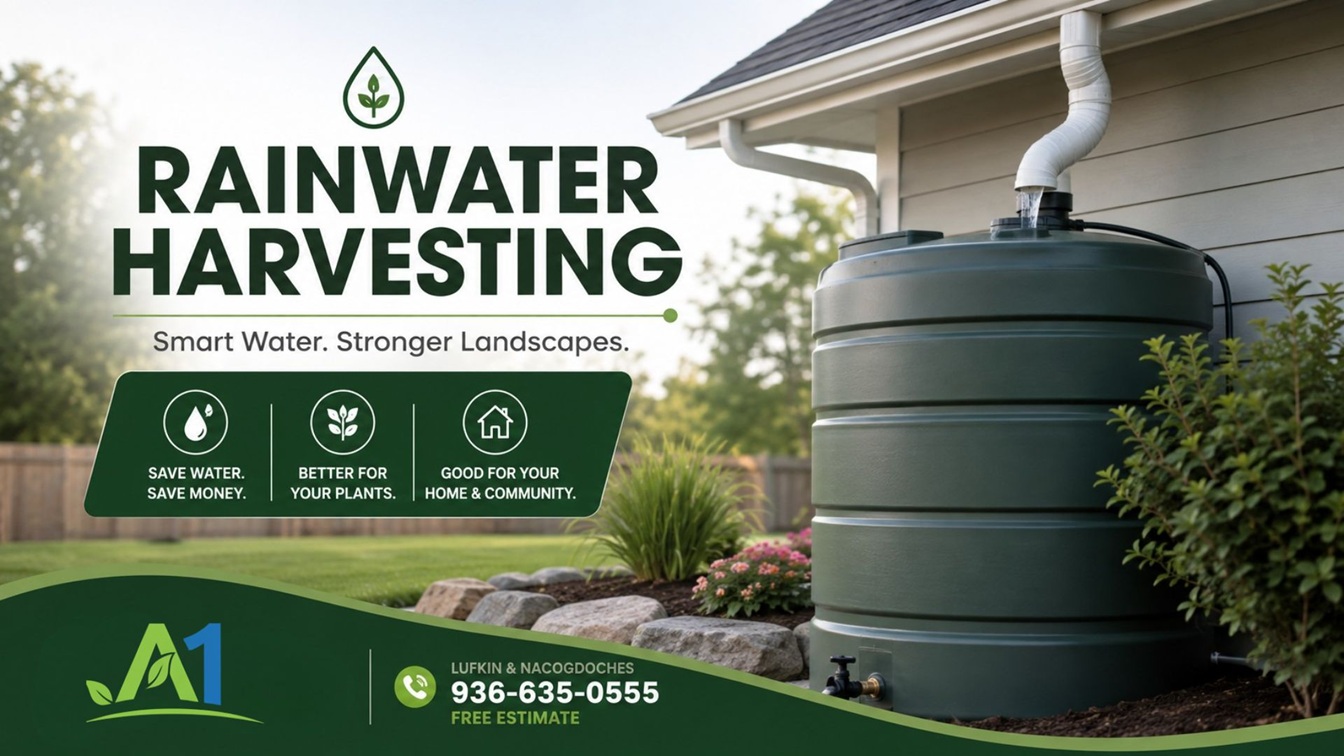
On the more serious end, you’ve got cisterns. These come in a range of materials—fiberglass, polypropylene, metal, concrete, and even wood—and they range in size from a few hundred gallons up to massive 37,000-gallon-plus systems for homeowners who want serious capacity. Larger cisterns typically come with filtration and pumping infrastructure, especially if the water is going to be used for irrigation or, in some cases, full domestic and even potable use.
For most homeowners thinking about landscape irrigation specifically, the sweet spot tends to be somewhere in the middle: a simple above-ground cistern connected to either a gravity-fed system or a small pump feeding into a drip irrigation line. That kind of setup can often be installed for a few hundred to a few thousand dollars, depending on size and complexity, and it can make a real, noticeable dent in a household’s water bill—especially during the hot summer months when irrigation is doing most of the work.
The Real Benefits, Beyond Just “Free Water”
Saving money on your water bill is the benefit most people think of first, and it’s a real one—once a system is paid for, the water it collects is essentially free. But it’s not the only reason this makes sense, and honestly, some of the other benefits matter just as much.
Rainwater is genuinely better for your plants. Rainwater has zero hardness. It doesn’t carry the dissolved minerals that municipal water or well water often does in our area. Over time, that hardness builds up in soil and can affect plant health, especially for more sensitive landscaping like flower beds and ornamental plantings. Rainwater goes on soft and stays soft.
It’s easier on your irrigation equipment, too. That same lack of mineral content means less scale buildup inside drip lines, emitters, and irrigation components—the kind of buildup that clogs systems and shortens their lifespan when you’re running hard water through them year after year. If you’ve got an irrigation system already, feeding it rainwater instead of straight municipal or well water can genuinely extend how long that equipment lasts.
It helps with runoff and erosion, too. Every gallon of rain that goes into a cistern instead of running off your roof and across your yard is a gallon that isn’t carrying soil, fertilizer, and other debris into storm drains and eventually into local waterways. On a property-by-property basis it’s a small thing. Across a whole neighborhood, it adds up to real environmental impact—less erosion, less non-point source pollution, and less strain on stormwater systems during our heavier rain events.
How to Actually Get Started
If this all sounds appealing but a little overwhelming, here’s how we’d suggest thinking through it:
- Start with your goal. Are you trying to water a vegetable garden and some flower beds, or are you trying to offset a meaningful chunk of your irrigation system’s water use? That answer determines whether you’re looking at a rain barrel or a cistern.
- Look at your roof. Your catchment area—basically the square footage of roof draining to a given downspout—determines how much water you can realistically collect. Bigger roof sections mean bigger potential yield.
- Think about placement. Cisterns need a stable, level surface and should be positioned where overflow water has somewhere sensible to go during a heavy rain event.
- Check local requirements. As mentioned, the state framework is favorable, but it’s worth a quick call to your local building or utility office, especially for larger systems, just to make sure you’re covered on any local permitting details.
- Decide on gravity versus a pump. Simple gravity-fed systems are cheaper and have fewer moving parts, but a small pump gives you more flexibility if you want to run drip irrigation lines across a larger area.
The Bottom Line
Texas has built a legal and tax framework that genuinely supports homeowners who want to collect rainwater—HOAs can’t ban it, the equipment is tax-exempt, and property tax exemptions can apply. Combine that with East Texas’s roughly 49 inches of annual rainfall, and you’ve got a setup where a modest investment in a rain barrel or cistern can capture tens of thousands of gallons of usable water a year, save money on irrigation, and be genuinely better for your plants and your equipment in the process.
It’s not a complicated decision so much as it’s an underused one. A lot of East Texas homeowners are sitting on more free water than they realize, running straight off the roof and into the yard.
A1 Lawn & Landscape proudly serves Lufkin, Nacogdoches, and surrounding East Texas communities. 📞 Call 936-635-0555 for a free estimate.
Author: Billy Forrest