

When we roll fresh sod off the truck and lay it across your yard, most homeowners see the finish line. The bare dirt is covered. The yard looks green again. Job done.
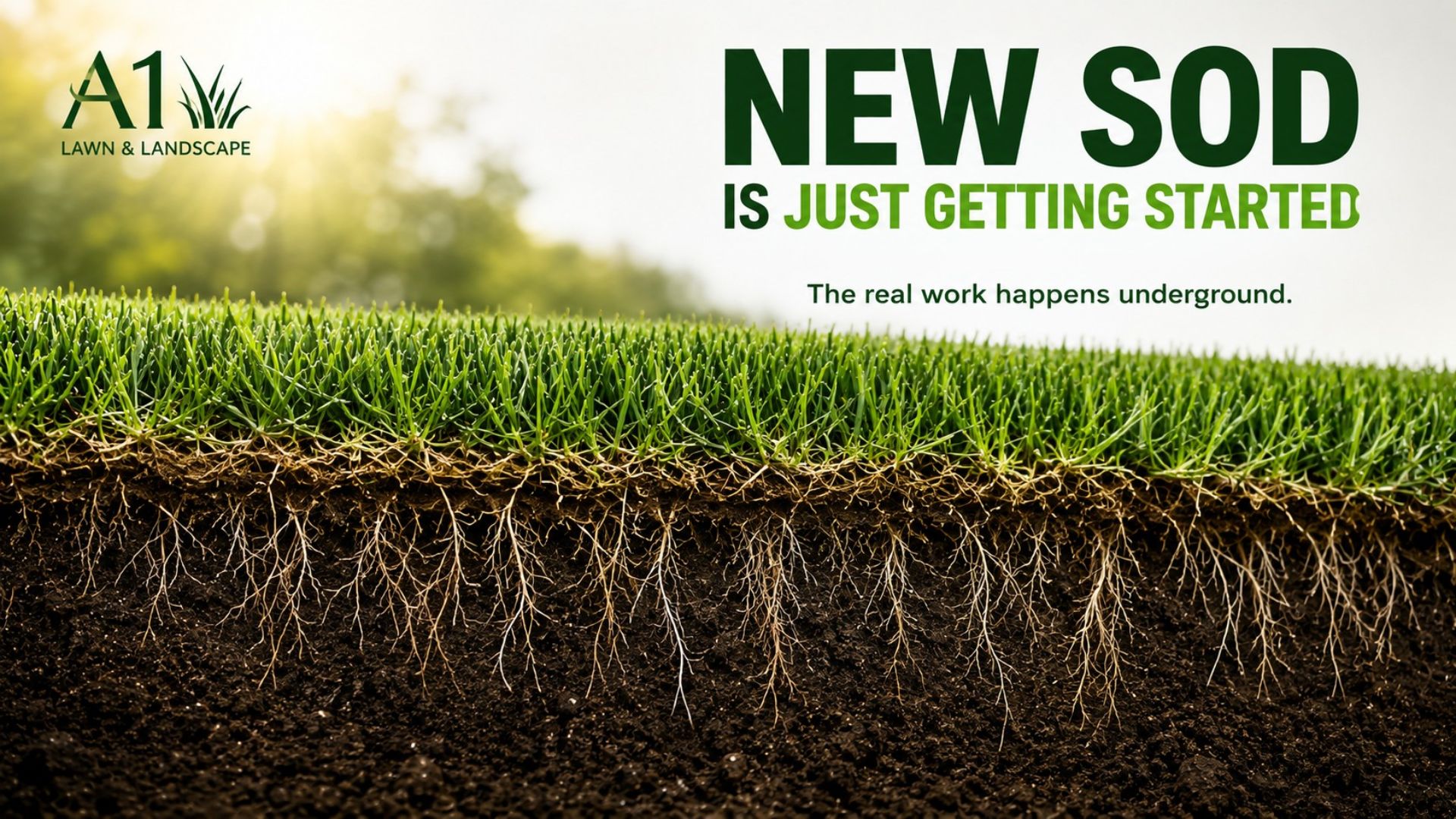
Underground, it’s a different story. What you’re actually looking at is the starting line of a race — a 12-month biological process that determines whether that beautiful new lawn thrives for years or struggles for seasons. Understanding what’s happening beneath the surface changes how you water, how you mow, and how patient you need to be during those first critical weeks.
Sod Doesn’t Start Life at Your House
Before that sod ever touches your yard, it spent 10 to 24 months growing as a crop on a sod farm, building up a full, healthy root system in open field soil. Then came harvest day.
Commercial sod harvesters cut beneath the root zone at a depth of only about a quarter to a half inch. That thin cut removes roughly 80% or more of the plant’s existing root system. The grass blades you see look perfectly healthy, but underneath, the plant just lost the vast majority of the roots it depends on for water and nutrients.
Here’s the part that matters for you as a homeowner: the canopy — the green leafy part you’re admiring — still needs the same amount of water and nutrients it always did. It just lost most of the plumbing that delivers them. From the plant’s perspective, sod harvest is a catastrophic event, and everything we do in the first weeks after installation is about helping it recover.
The First 24 Hours: Winning or Losing at the Soil Interface
The clock starts ticking the moment sod is cut. Blade tissue begins dehydrating within minutes of being lifted off the field, which is why timing matters so much on installation day.
Fresh sod should be watered within 30 minutes of being laid — not after the whole yard is finished. On larger projects, it’s common for two to four hours to pass between laying the first pallet and the last. Those early sections sit exposed and drying out while the crew works across the rest of the yard, so we water in stages rather than waiting until everything is down.
Once the sod is laid and watered, we roll it with a water-filled lawn roller. This step gets skipped more often than it should, but it matters. Rolling presses the sod into firm, direct contact with the soil underneath and eliminates air pockets that would otherwise block new roots from reaching the ground. Turf research out of the University of Nebraska Extension has confirmed that proper soil-to-sod contact is one of the top predictors of whether a lawn establishes successfully. Without that contact, new roots have nothing to grow into.
Days 1-7: A Biological Emergency
For the first week, your new lawn is essentially living off its savings. Stored starches in the crown and in whatever root tissue survived harvest are what keep the canopy alive while the plant scrambles to build new roots.
The good news is that recovery starts almost immediately. Severed root ends begin sealing themselves off through a process called callus formation within hours of contact with moist soil. And under favorable conditions, the plant starts growing brand-new roots from root-forming buds at the crown — called the adventitious root system — within the first 24 hours.
This is why watering during week one looks different from watering a mature lawn. We recommend frequent, shallow watering — two to four times a day for short durations — to keep the sod and the top inch of soil consistently moist. The new roots forming right now are shallow and tender, and they need that top layer of soil to stay damp so they don’t dry out and die before they get established.
One of the most common mistakes homeowners make is continuing that aggressive, frequent watering schedule well past week one. It feels like the safe thing to do, but it actually trains the roots to stay shallow, since they never have to search downward for water. The result is a lawn that looks fine at first but stays permanently drought-sensitive.
Days 7-14: The Tug Test Tells the Truth
By day 10 to 14, under favorable weather, the new shallow roots have grown enough to give the sod real anchorage in the soil. This is the point where we stop guessing and start testing.
The tug test is simple and it’s the most reliable field indicator of how establishment is actually going: grab a handful of grass blades firmly with both hands and lift straight up. If the sod comes up easily, it’s not ready. If it resists — if you feel real resistance from roots holding it down — establishment is underway.
As the University of Nebraska Extension puts it, “when the sod resists being lifted, usually within 10 to 14 days during optimum weather conditions, the frequency of irrigation should be reduced but the amount of water applied during each irrigation cycle should be increased.” In plain terms: water less often, but water deeper. That shift is what starts pushing the roots downward instead of keeping them near the surface.
Weeks 2-4: Building the First Real Root Mat
Once the tug test passes, the root system starts transitioning from a handful of sparse, fine roots into a denser mat of fibrous roots occupying the top two to four inches of soil. This is the lawn starting to knit itself together.
It’s also usually the point where the first mow makes sense — typically two to three weeks after installation, once the tug test has passed. We set the mower to its highest setting for that first cut and never take off more than a third of the blade height in a single pass. Mowing too short too early stresses a lawn that’s still putting most of its energy into root development rather than leaf growth.
Here’s a fact worth understanding, straight from the folks at CT Sod who study turfgrass root biology: “The first root system the plant develops is temporary. The first fine roots that establish in weeks 1-2 are a short-term solution — they keep the plant alive while the true adventitious root system develops from the crown. The long-term lawn runs on the adventitious system, which develops progressively over the first 6-8 weeks.”
That’s worth sitting with. The roots you’re protecting in week one aren’t the roots your lawn will run on for the next several years. They’re a bridge. The real foundation is still being built.
Weeks 4-8: The Phase That Determines Everything Long-Term
If we had to point to one stretch of time that matters most for how your lawn performs for years to come, it’s weeks four through eight. This is when the permanent adventitious root system really develops — the system your lawn will actually rely on for the rest of its life.
The single most important thing you can do during this phase is water deeply and infrequently. That sounds counterintuitive after weeks of frequent watering, but it’s exactly the opposite instinct that’s now correct. Deep, infrequent watering forces roots to grow downward, searching for moisture instead of sitting comfortably near the surface. Lawns that get this phase right end up with roots that reach real depth — lawns that get it wrong end up shallow-rooted and fragile no matter how good they looked at 30 days.
This is also usually where we start fielding calls from homeowners who did everything right early on and are tempted to ease off entirely because the lawn “looks done.” It doesn’t look done because the color changed — it looks done because the leaf canopy fills in fast. The roots underneath are still very much a work in progress.
Months 3-12: From Established to Mature
By around month three, a well-established sod lawn should look and function like it’s been there for years — functionally indistinguishable from a mature lawn to the naked eye.
But root growth doesn’t stop there. Root depth keeps increasing throughout the entire first growing season. Bermudagrass, under ideal conditions, can ultimately send roots down as deep as six feet. That’s not a typo — six feet of root depth is what gives established Bermuda lawns their exceptional drought tolerance during East Texas summers. A lawn with that kind of root system can pull water from soil moisture reserves most homeowners never think about, which is exactly why the first few months of care matter so much. Every shortcut taken early — watering too shallow for too long, mowing too soon, skipping the roller — shows up later as a lawn that never develops that deep reserve.
Why This Matters More Than the Green You See
It’s easy to judge a new lawn by color alone. Green means healthy, right? Not necessarily — at least not yet. A sod lawn can look fully green within days of installation while the root system underneath is still in crisis mode, running on stored starches and a handful of fragile new roots.
The color you see in week one is mostly the old canopy holding on. The real health of your lawn — the part that determines whether it survives a dry August, bounces back from foot traffic, and needs less water year after year — is happening below ground, invisible, for months.
This is where experience matters. Knowing when to water heavy and when to pull back, when the tug test says “go” and when it says “wait,” and how to read a lawn that looks fine on top but isn’t ready underneath — that’s the difference between sod that establishes into a resilient East Texas lawn and sod that struggles for a full season because it never got the chance to build real roots.
The Bottom Line
New sod isn’t finished the day it’s laid — it’s just getting started. The first two weeks are about survival and soil contact. Weeks two through four build the first real root mat. Weeks four through eight determine how deep and how drought-tolerant your lawn will ultimately become. And the process keeps unfolding for a full year after that.
Get the watering schedule right, respect the tug test instead of a calendar date, and be patient with mowing, and you’ll end up with a lawn whose roots can handle whatever an East Texas summer throws at it.
If you’re installing new sod or wondering whether a struggling lawn ever got the root system it needed, professional guidance can make the difference between a lawn that survives and one that truly thrives.
A1 Lawn & Landscape proudly serves Lufkin, Nacogdoches, and surrounding East Texas communities. 📞 Call 936-635-0555 for a free estimate.
Author: Billy Forrest