


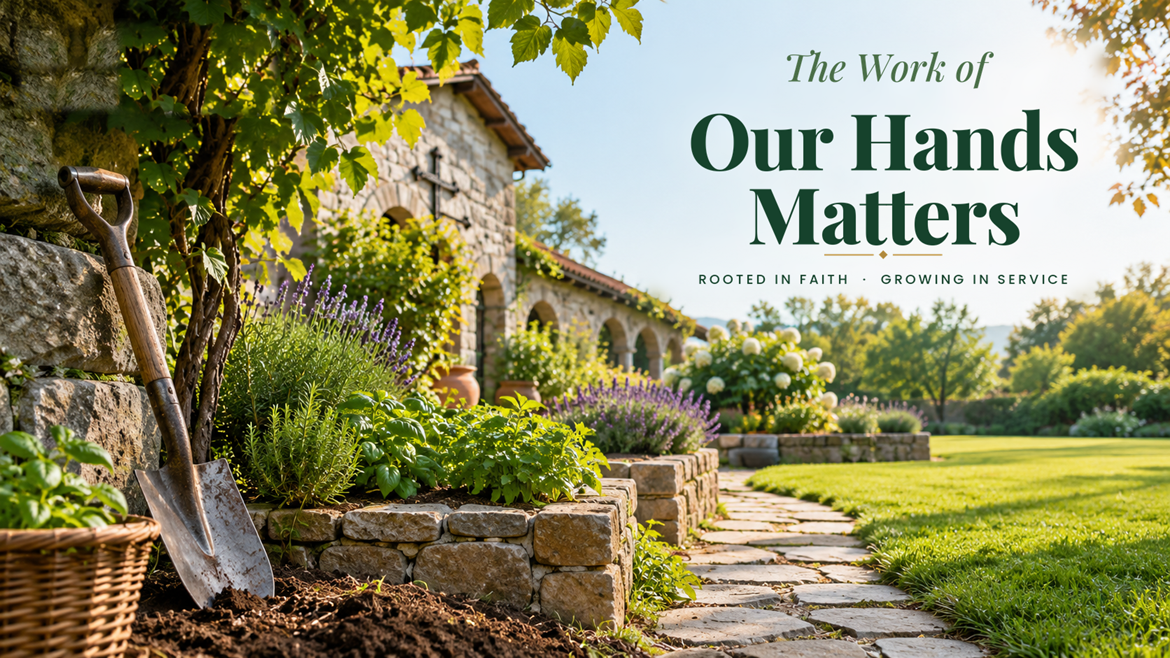
Every November, as the days shorten and the yard work slows down enough to actually think for a minute, we like to step back from mowing schedules and irrigation checks and talk about something a little deeper. This month, we want to tell you about two Latin words that have quietly shaped how we think about our work at A1 for as long as we’ve been in business: ora et labora — “pray and work.”
It’s not a marketing phrase. It’s fifteen hundred years old, and it comes from a monastery.
Where the Idea Started
Back in the year 480, in the Italian town of Nursia, a man named Benedict was born who would go on to change how the Western world thought about labor. Around 530 CE, Benedict founded a monastery at Monte Cassino and wrote down a set of guidelines for how monks should live together — eat, pray, sleep, and work. Historians call it the Rule of Saint Benedict, and it went on to govern daily life in Benedictine monasteries for more than 1,500 years. Some version of it is still followed today.
What made the Rule remarkable wasn’t just its structure. It was its stubborn insistence that manual labor — gardening, farming, building, kitchen work — wasn’t a distraction from a monk’s spiritual life. It was his spiritual life, expressed with a hoe instead of a hymnal.
William P. Hyland, who studies the Benedictine tradition at the University of St Andrews, put it about as plainly as it can be put: “All things belonging to the monastery are sacred vessels, with the tools of the fields and kitchen to be no less cherished and cared for than the vessels used for the Eucharist. All work is sacred.”
Read that again. A garden spade, cared for the same way you’d care for a chalice used at the altar. That’s not a metaphor to Hyland — that’s how Benedict’s monks actually lived. The plow and the prayer book sat on the same shelf, spiritually speaking.
The Garden That Proves It
If you want to see what “all work is sacred” looked like in practice, there’s no better window into it than the Plan of Saint Gall — the most detailed surviving drawing of a medieval monastery, sketched out in the 9th century as a kind of ideal blueprint for how a Benedictine community should be laid out. It’s an architectural drawing, but if you look closely, it reads almost like a devotional document.
The Plan lays out three distinct garden spaces, each with its own purpose:
- The kitchen garden (hortus) — eighteen rectangular beds, each planted with a specific crop: onions, leeks, celery, coriander, dill, poppy, radishes, parsley, chervil, lettuce, savory, parsnips, cabbage, garlic, shallots, fennel. This garden fed the community, meal after meal, season after season.
- The physic garden (herbularius) — sixteen beds of medicinal herbs, including roses, lilies, sage, rue, and mint. This garden healed the sick.
- The orchard (pomarius) — thirteen fruit trees, planted in rows. This garden fed the community too, in season, and gave shade the rest of the year.
Here’s the detail that stops people when they first hear it: the orchard doubled as the monastery cemetery. The monks were buried among the fruit trees they had planted and tended. Their bodies returned to the very soil that had nourished them in life.
Sit with that for a second. The same ground that grew the apples on a monk’s table was the ground he’d eventually be laid to rest in. There’s no clearer picture of what it meant, in that world, for a person’s labor to be woven into the full cycle of life — planting, harvest, healing, and, finally, rest.
The monk who tended that garden wasn’t just a gardener. He was a steward of the land, a healer through the physic beds, a provider through the kitchen garden, and — in the end — a participant in the whole arc of life and death the garden represented. His labor wasn’t separate from his prayer. It was his prayer, said in soil, seed, and season instead of words.
How the Idea Got Out of the Monastery
For a long stretch of the medieval world, this kind of thinking — that ordinary labor could be holy — stayed mostly behind monastery walls. The work of priests and monks was considered a higher calling than the work of farmers, carpenters, or anyone else making a living with their hands.
The Protestant Reformation cracked that idea open. Martin Luther’s doctrine of the “priesthood of all believers” pushed back hard against the notion that some work was spiritually superior to other work. Luther argued that a farmer plowing a field or a mother raising children was serving God just as fully as a monk in a chapel — every legitimate occupation was, in its own way, a calling. John Calvin picked up that thread and wove it into a fuller theology of vocation, one that shaped what we now think of as the Reformed work ethic — the idea that showing up and doing honest work well is itself a form of worship.
That line of thinking didn’t stop in the 1500s. It runs straight through to a book many people have read more recently: Timothy Keller’s Every Good Endeavor, published in 2012. Keller argued that “work has dignity because it is something that God does and because we do it in God’s place, as his representatives.”
From Benedict’s monks tending sacred gardens, to Luther and Calvin dignifying the work of every believer, to Keller putting it in terms a modern reader can carry into a Monday morning — it’s the same idea, fifteen hundred years running: the work of your hands matters, and it’s worth doing well.
What This Has to Do With Your Lawn
We’ll be honest — most Mondays at A1 don’t feel like a monastery. There’s a trailer to load, a mower that won’t start, a client who wants their sod down before the weekend. But underneath the day-to-day, this is the tradition we’re standing in.
When one of our crew members kneels down to check soil compaction before we lay sod, or takes an extra ten minutes to make sure a drip line is actually reaching the root zone instead of running off the surface, that’s not just professionalism. It’s an echo — however small — of a monk tending eighteen beds of vegetables because the work itself was worth doing right.
We don’t say this to make trimming a hedge sound more dramatic than it is. We say it because we think it’s true: work done with care, on land God made, for a neighbor you know by name, is worth something beyond the invoice. That’s part of why we started A1 the way we did, and it’s baked into our tagline — Rooted in Faith. Growing in Service. We didn’t pick those words because they sounded nice on a truck door. We picked them because they describe what we’re actually trying to do out there.
It’s also part of why we think there’s a real difference between a locally rooted crew and a big national outfit dispatching whoever’s available that week. When the work is a calling and not just a route on a clipboard, you tend to notice things — the low spot that drains wrong, the bed that gets afternoon sun nobody accounted for, the fence line where the last company’s crew clearly rushed. Fifteen hundred years of thinking about work as sacred tends to produce a different kind of attention to detail than “get to the next stop by three.”
A Season for Slower Thinking
November has a way of slowing things down in East Texas. The grass isn’t growing fast, the planting windows are narrower, and there’s more time to think than there is in July. We think that’s a good use of the season — not just to plan next year’s beds, but to remember why the beds matter in the first place.
Saint Benedict never met a Bermuda lawn or a French drain. But he understood something we still believe: that the work of your hands, done faithfully, is not separate from the rest of your life. It’s part of it. A well-tended garden fed a monastery for a thousand years. A well-tended yard can feed something in a family too — a place to gather, to rest, to watch kids grow up and dogs get old, to sit outside on a cool November evening because the ground under your feet is cared for.
The Bottom Line
The belief that “all work is sacred” isn’t a modern feel-good idea — it’s a fifteen-hundred-year-old conviction, traced from Saint Benedict’s monastery, through the gardens of the Plan of Saint Gall, through the Reformation’s dignifying of ordinary labor, and into how we try to show up on your property today. When we’re out at your place this fall — checking your beds, prepping your soil, laying your sod — we’re trying to carry a little bit of that tradition with us. Not because it’s good marketing, but because we actually believe it.
A1 Lawn & Landscape proudly serves Lufkin, Nacogdoches, and surrounding East Texas communities. 📞 Call 936-635-0555 for a free estimate.